If the Ones Doing the Work Reset the Flow
The October shutdown talk never became a national stop. The question it left is what drivers could gain if they used the power already in the seat
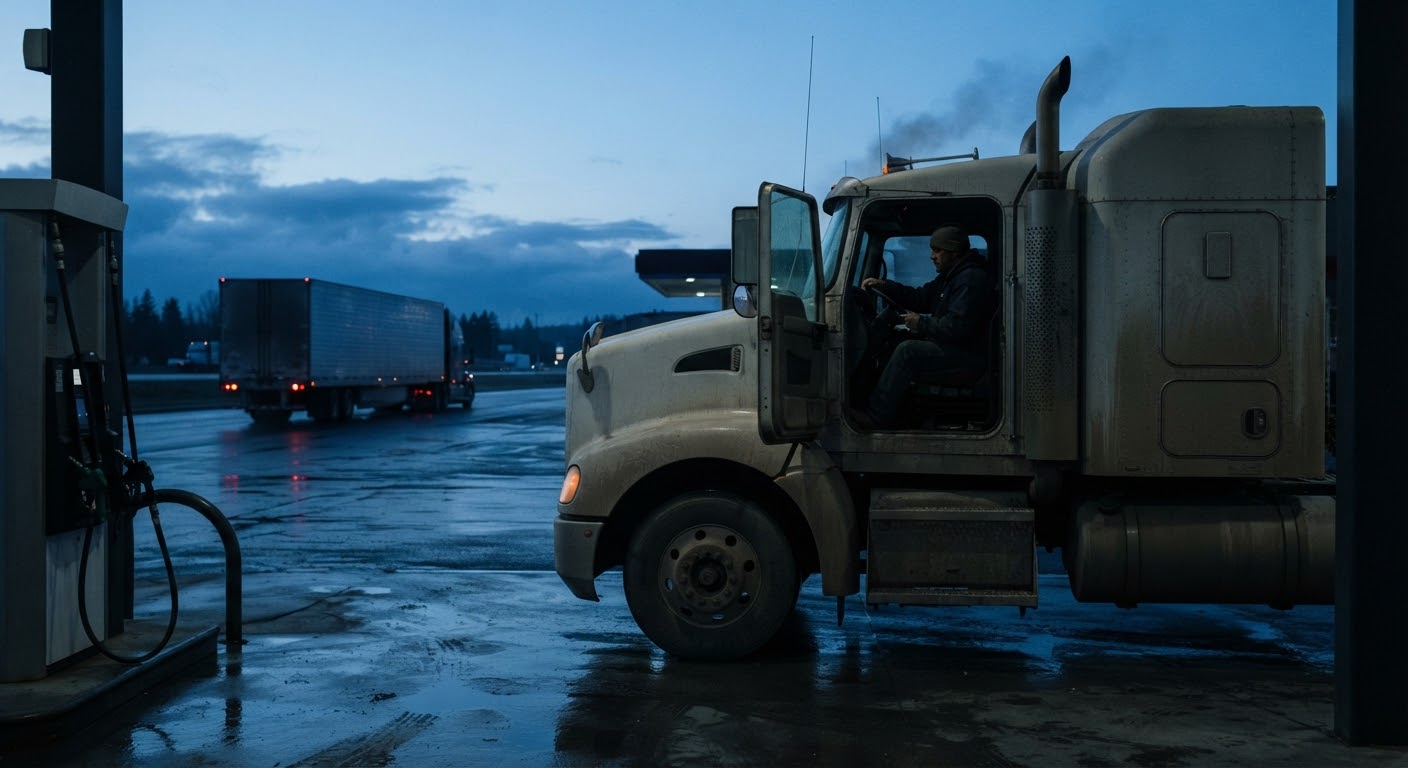
A call moved across the feeds at the end of September. American drivers were going to park from October 1 through October 5. The reason attached to the call was diesel. The picture attached to it was empty shelves. Who posted it first does not decide anything. A driver may have started it. A page that does not own a truck may have started it. The discussion is what the call was worth, and what the people doing the work could gain if they used the leverage they already have.
Snopes looked at the claim on September 30 and found no proof of an organized nationwide strike. The Owner-Operator Independent Drivers Association told Snopes the talk matched what the fact-check was seeing. Social media chatter. No endorsed list. No sign-up anyone could count. CDL Life reported industry leaders saying the same thing in the days before the date. A nationwide stop was not forming. October 1 arrived. Some owner-operators sat. A few called it a protest. At least one called the week a vacation. Freight kept moving. By October 3 the posts had changed shape. People were asking where the shutdown went.
What the chatter did not have was organization. It also did not have anyone out front. No association stood up as the head of it. No carrier group did. No driver stood in front of the call with a list, a count, and the information the people who haul would have needed before they decided to sit. Voices said they would park. None of them was the representation for the chatter. The posts had a date and a diesel price. They did not have a head. A driver scrolling the feeds could not tell a real ask from a repost, because there was nowhere the ask was delivered except the feed itself.
That is the gap. Had there been a tool built for this industry, and for chatter like this, the information could have been delivered to the drivers it was about. Who was calling it. What they were asking. What was actually known. What was not. The people who would have had to park could have gotten that in one place, wherever the truck was, instead of piecing it together from strangers. The call still might not have become a stop. It would have been a discussion with a front, not a pile of posts with none.
That result does not retire the question. It leaves the question standing without a crowd around it.
Drivers hold more of the economy in the seat than the industry talks like they do. The American Trucking Associations puts the share of U.S. freight moved by truck at about 72.7 percent of tonnage in 2024. The trucking freight bill that year was estimated at $906 billion. The count of professional drivers was 3.58 million. A rail car does not pull into a grocery dock. A pipeline does not set a coil of steel in a yard at 4 a.m. The last mile, and most of the miles before it, is a truck with a person in it. Coverage is a driver. Capacity is a driver. The appointment on the dock is a promise a driver has not kept yet. That is an exalting amount of power, and it gets treated like background. Drivers treat it that way too. A week of posts about parking the trucks was the first time in a while the leverage was said out loud.
The flow on top of that work is where the gain sits. It is also where the gain gets lost.
Fuel is paid at the island before anyone else settles the load. The U.S. Energy Information Administration put the national average for on-highway diesel at $6.382 a gallon for the week of September 28. That was down 14.7 cents from $6.529 the week before, and up $2.628 from $3.754 a year earlier. California was at $8.181 that same week. The Lower Atlantic was at $5.953. The next release is October 6, so the September 28 week is the number this piece uses. A driver burning 150 gallons in a thousand miles is not arguing a theory at that pump. The difference against last year is hundreds of dollars on one fill.
The tax is attached to the same gallon. EIA puts the federal tax on on-highway diesel at 24.40 cents a gallon, an excise of 24.30 cents plus a tenth of a cent for the leaking-tank fund. The average of state diesel taxes was 35.50 cents as of January 2026, before county and local tax. The American Trucking Associations reports commercial trucks paid $30.26 billion in federal and state fuel taxes in 2023. None of that is collected from a broker. It is collected because a truck moved. A reset that started with the ones doing the work would start by watching that price and that tax as hard as the driver's clock is watched. Not as a speech. As a number someone is accountable for, the way a log is accountable.
Then the cut in the middle. A broker is paid to put a shipper's freight on a truck. The spread between what the shipper paid and what the truck was tendered is the skim. Drivers do not need a study to see it. It is on the rate confirmation, next to the miles, under what the load was supposedly worth. The shipper often never sees the truck's number. The driver often never sees the shipper's number. The difference stays in the middle. If that cut came off the top of the load instead of off the truck, the money does not leave the freight. It is still in the load. A reset asks who it is for.
Companies sit in the same flow, and the public numbers show how little of the recent pressure moved toward the seat. FreightWaves reported the American Transportation Research Institute 2026 cost study, which put the average cost to run a truck at $2.336 a mile in 2025. That was a record. Driver wages in the study rose 2.5 percent, which ATRI called sub-inflationary. Costs excluding fuel rose faster than inflation. Truckload operating margin in that report sat at 0.4 percent. Benefits were a line on the same sheet, not a plan a driver would describe as coverage. Vacation in this work is usually unpaid time at the house. Insurance is something a driver hopes not to test. This is not a challenge thrown at an office. It is the shape of the flow as it runs now. The work is at the bottom. The split is decided above it.
Here is the whole question. If the ones doing the work reset that flow, what do they gain.
Fuel monitored, not just paid at the island and forgotten. The skim taken off the load, not off the truck. A company that clears more because the freight still has to move and the cut in the middle got smaller. Then the part that never makes a rate sheet. Room to share what was cleared. Pay that matches the work. Insurance that covers a family instead of a deductible. Vacation that is time off, not a week the driver finances. A share of what the truck actually earned, written where a driver can see it.
A shutdown was one way to force that conversation into the open. It did not happen as a national stop. The leverage did not leave with the posts. It is still in the seat, on the next dispatch, under the next rate. The feeds were a bad room for the discussion. A driver, a carrier, and a stranger with a repost button all counted as the same voice. The argument broke into content before it became a plan. Empty shelves were the picture. The gain was never the picture.
Diesel Verified Tech is the kind of tool that gap was missing. Drivers only. Built so a note or a clip from inside the industry can reach the people who haul, wherever the truck is, without passing through a timeline that pays whoever shouts. In a week like this one, that is the difference between chatter with no head and information a driver can actually use. It does not set the price of diesel. It does not write the rate confirmation. It gives the discussion a room that belongs to the industry, so the next call can be delivered to the people who would have to park, not left for strangers to carry. The other perks around that room are real. They are not the point of this week. The point is the flow, and who is in a position to reset it